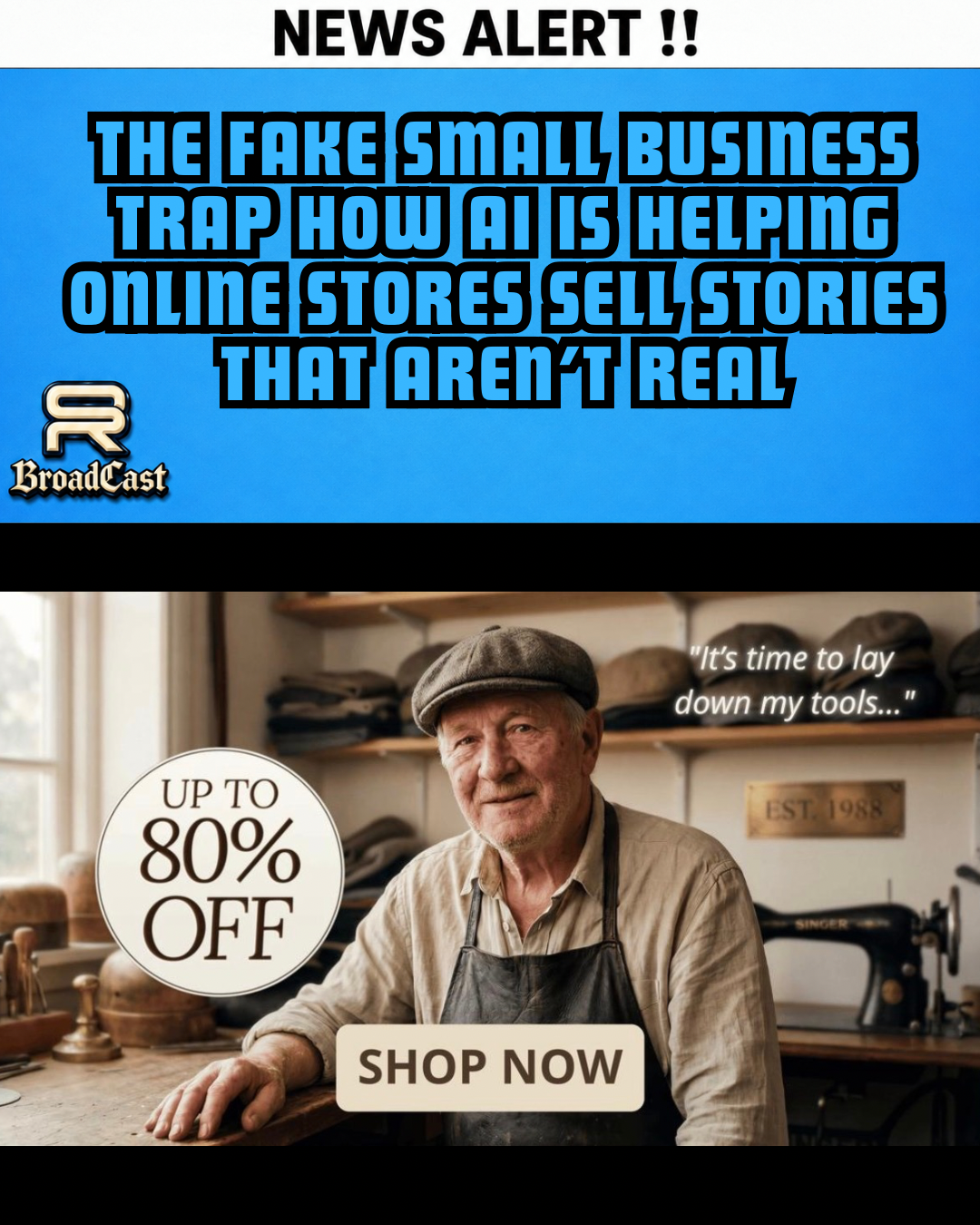
THE FAKE SMALL BUSINESS TRAP: HOW AI IS HELPING ONLINE STORES SELL STORIES THAT AREN’T REAL
Online shoppers are being targeted by a growing kind of deception: websites that look like small, family-owned businesses but use artificial intelligence to manufacture the people, products, and emotional backstories behind their brands.
The pitch can sound familiar. A longtime craftsperson is supposedly retiring after decades of work. A family-owned boutique claims it is closing its doors. A small business owner says a personal hardship has left them with no choice but to sell everything at a discount.
The customer believes they are buying from a real person, supporting an independent business, or helping someone through a difficult moment. But in some cases, the story is fabricated to sell ordinary mass-produced merchandise at prices that suggest something far more valuable.
This is no longer just a concern about suspicious emails or obvious counterfeit websites. Investigations published in 2026 have documented online retailers using AI-generated imagery, videos, and backstories to make questionable businesses appear authentic. The result is a new challenge for consumers: when a business looks real, how can shoppers know whether the story behind it is real, too?
The emotional sales pitch behind the fake storefront
In a May 8, 2026, visual investigation, ABC News identified dozens of online retailers that used AI-generated images and videos to portray themselves as struggling independent businesses.
One example involved advertisements for supposedly handmade caps. The advertising presented a craftsman who had spent decades making products by hand and was preparing to retire. A customer, musician and small-business owner Denny Svehla, told ABC News that the story persuaded him to make a purchase and even leave a tip.
His suspicions grew when shipping information indicated that the hats were coming from mainland China. When they arrived, he was disappointed with their quality and frustrated that the story that influenced his purchase appeared misleading.
ABC News also documented other websites using similar tactics, including claims of store closures and business hardship supported by images experts assessed as AI-generated.
The important distinction is that manufacturing a product overseas does not automatically make a company dishonest. Legitimate businesses import products every day, and inexpensive products are not necessarily scams.
The concern is whether a seller is misrepresenting where its products come from, how they are made, who is selling them, or why a customer should pay a premium.
A retailer can sell a mass-produced hat honestly. Presenting that hat as the work of a fictional craftsman with 53 years of experience is an entirely different matter.
Why artificial intelligence changes the game
Fake online stores are not new. Fraudsters have long copied legitimate websites, advertised merchandise they never intended to deliver, or disappeared after collecting payments.
What AI changes is how quickly and convincingly a questionable business can be created.
A seller can generate a realistic-looking founder, a workshop filled with merchandise, promotional videos, a storefront photograph, and a sentimental company history without having the real people or physical business those materials appear to depict.
The same process can be repeated across multiple websites. Different store names and slightly different stories can give the impression that consumers are discovering separate independent businesses when their marketing follows nearly identical patterns.
That makes the deception harder to recognize through appearance alone. A polished website, professional-looking photographs, and a sympathetic founder's story are no longer reliable proof that a business operates as advertised.
There is also a financial incentive behind the strategy. A generic product can be difficult to distinguish from thousands of competing listings. A story about a craftsperson retiring after a lifetime of work creates a different emotional response.
Instead of simply comparing prices, customers may feel they are purchasing something special, preserving a tradition, or helping a person in need.
That emotional connection can make people less likely to investigate the seller before checking out.
The warning signs are often hiding in plain sight
Not every suspicious website will display obvious spelling mistakes, broken links, or strange-looking photographs. Some are designed to look more professional than legitimate small businesses.
Consumers should look beyond the storefront and investigate the company itself.
1. The business story is unusually dramatic.
Be cautious when a seller relies heavily on emotional claims about retirement, illness, financial hardship, a family tragedy, or a sudden store closure—especially when the story is paired with a countdown timer or an urgent, supposedly final sale.
The story may be true, but it should not replace basic verification.
2. The business cannot establish where it operates.
Look for a physical business address, working contact information, a clear company identity, and a consistent history. Search the business name separately from its own website to see whether independent sources corroborate its claims.
An address that leads nowhere, contact details that do not work, or a supposed local business with no verifiable local presence should prompt further investigation.
3. The discounts and claims do not add up.
A website advertising extraordinary markdowns on every product while repeatedly claiming to be closing may be using urgency to discourage comparison shopping.
Check the same product elsewhere. If a supposedly handcrafted item appears across unrelated stores at substantially different prices, investigate before assuming it is unique.
4. The return policy creates obstacles.
Read the return and refund terms before paying. Look for vague language, expensive international return shipping, unclear deadlines, or instructions that make it difficult to identify the company responsible for refunds.
A professional-looking website is not a substitute for a workable return policy.
5. The photographs and videos deserve a second look.
Search for the business name, product photographs, and distinctive phrases from its advertising. Reverse-image searches can help reveal whether the same supposed founder or product image appears under different business names.
AI detection tools may provide clues, but they are not definitive proof. A suspicious image should lead to further verification, not an automatic conclusion that the seller is fraudulent.
These checks reflect the kinds of warning signs highlighted in consumer reporting on deceptive online retailers.
Why this matters to legitimate small businesses
The consequences extend beyond the person who receives a disappointing package.
Independent businesses depend on trust. A local artist selling handmade products, a family-owned clothing store, or a small manufacturer may spend years building a reputation through customer service, consistent quality, and personal relationships.
A deceptive competitor can imitate that presentation without carrying the same costs or responsibilities.
When customers discover that an emotional sales pitch was fabricated, their frustration can spread to other independent sellers. Shoppers may become less willing to trust unfamiliar businesses, even when those businesses are legitimate.
The problem also complicates online advertising. Consumers often encounter products through short videos, sponsored posts, and recommendations rather than through a store they already know. In those environments, a compelling story can be the first—and sometimes only—thing a buyer sees before making a purchase.
The Better Business Bureau has also warned about AI-assisted product imagery, fake reviews, and fabricated endorsements. A product photograph may create expectations that the actual item cannot meet, while invented social proof can make a questionable seller appear more established than it is.
For independent entrepreneurs, the lesson is not to abandon AI or online advertising. It is to recognize that the same tools that help legitimate businesses create marketing materials can also help dishonest operators manufacture credibility.
What shoppers can do before spending money
Consumers do not need to become technology experts to reduce their risk. A few deliberate steps can make a meaningful difference.
Search independently. Look up the business name alongside words such as “reviews,” “complaints,” and “returns.” Do not rely exclusively on testimonials published by the seller.
Verify the company. Check whether its address, contact details, ownership claims, and business history are consistent with the story it tells.
Compare the product. Search for the item or image elsewhere to see whether it is widely available under different names.
Read the fine print. Understand shipping times, return costs, refund conditions, and the identity of the company taking your payment.
Avoid pressure purchases. A countdown clock or claim that a business is closing tomorrow should not prevent you from doing basic research.
Use payment methods with protections. Credit cards and other eligible payment services may offer dispute procedures for qualifying purchases. Review the provider's terms and act promptly if something goes wrong.
If a purchase turns out to be deceptive, save the advertisement, order confirmation, website address, product listing, shipping records, and communications with the seller. Contact the payment provider to ask about dispute options and report suspected fraud to the appropriate consumer-protection agency.
The bigger issue: Trust is becoming harder to verify
The internet has always made it possible for a small business to reach customers far beyond its hometown. That access has helped independent artists, makers, and entrepreneurs build businesses without needing a major storefront or a large advertising budget.
But the same environment allows a seller to imitate the appearance of a genuine small business without building the underlying operation.
AI makes that imitation cheaper and faster. A convincing face, a detailed backstory, and a polished product video can now be generated without the years of work those materials claim to represent.
That does not mean every unfamiliar online store is dishonest, every AI-generated image is deceptive, or every emotional advertisement is a scam. AI is a legitimate tool for design, marketing, and communication.
The dividing line is honesty: whether a business accurately represents its products, its people, and its operations.
For shoppers, that means learning to separate a persuasive presentation from verifiable evidence. For entrepreneurs, it means understanding that genuine credibility is built through transparency, reliable service, and claims that can withstand scrutiny.
What happens next?
As AI-generated marketing becomes more realistic, consumers will face an ongoing challenge distinguishing authentic businesses from operations built around misleading identities and stories.
Online marketplaces, advertising platforms, payment providers, and consumer-protection agencies all have a role to play in addressing deceptive sellers. However, the speed at which new websites can appear and disappear makes enforcement difficult, particularly when operators work across borders.
For now, shoppers should not have to decide whether to trust a business based solely on how convincing its photographs look or how moving its story sounds.
A business's history, product quality, contact information, and policies matter more than the emotion of its advertisement.
SR BROADCAST TAKEAWAY: AI is making it easier to manufacture the appearance of a real small business. The biggest warning sign is not simply a suspicious photograph or an unusually low price—it is a seller whose emotional story cannot be backed up by verifiable facts. Before supporting a business online, make sure you know who you are actually buying from.