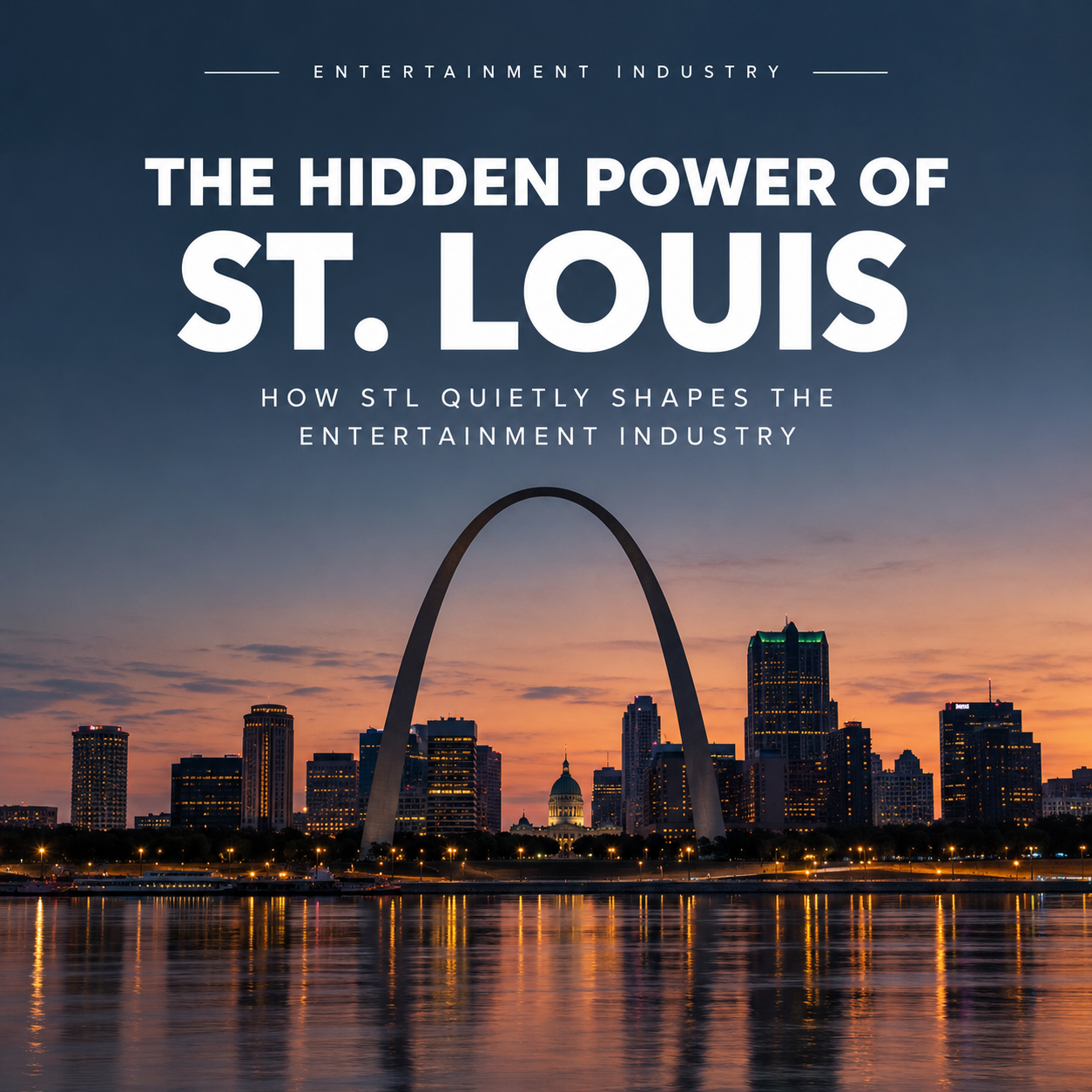
The Hidden Power of St. Louis: How STL Quietly Shapes the Entertainment Industry
Article By Kendrick Miles | October 2026
A City With More Influence Than Recognition
When people discuss the entertainment industry, the conversation often centers on Los Angeles, New York, Atlanta, and Nashville. These cities have established reputations as major centers for music, film, and celebrity culture. However, another American city has played a significant role in shaping the entertainment landscape for generations: St. Louis, Missouri.
St. Louis is more than a city with a rich musical history. It is a place where influential sounds emerged, artists developed their identities, and creative communities helped shape the direction of American entertainment. From ragtime and blues to jazz, rock and roll, and hip-hop, the city's cultural contributions have reached audiences far beyond Missouri. Explore St. Louis highlights this legacy as part of the city's broader influence on American music.
Yet, despite this history, St. Louis does not always receive the same national recognition as other entertainment markets. That disconnect raises an important question: How much influence can a city have on an industry without receiving equal recognition for its contributions?
The Sound of St. Louis Has Traveled the World
St. Louis' influence begins with its music.
The city helped cultivate generations of musicians who shaped American popular culture. Ragtime pioneer Scott Joplin, jazz legend Miles Davis, rock and roll innovator Chuck Berry, and internationally recognized hip-hop artist Nelly represent different eras of a musical tradition that continues to evolve.
Each generation contributed something different. Ragtime helped influence the development of American popular music. Blues and jazz expanded the possibilities of musical expression. Chuck Berry helped establish the foundations of rock and roll, while Nelly brought St. Louis hip-hop into the mainstream during the early 2000s.
Nelly's success demonstrated that an artist from the Midwest could compete at the highest levels of the music industry without originating from a traditional coastal entertainment center. His breakthrough helped introduce St. Louis' distinctive sound, style, and identity to a worldwide audience.
According to St. Louis Magazine, Nelly's Country Grammar reached the top of the Billboard 200, helping establish the city as a recognizable force in mainstream hip-hop. His success became an important reference point for artists seeking to build careers from the region.
The larger lesson is that St. Louis has never simply followed musical trends. At different points in American history, it has helped create them.
The Influence Goes Beyond the Artists
The entertainment industry is built on more than performers. Behind every successful artist is a network of producers, songwriters, engineers, promoters, managers, photographers, videographers, venue operators, and independent businesses.
St. Louis has long supported creative communities that contribute to this larger ecosystem. Its local venues, recording environments, radio history, and independent music culture have helped create opportunities for talent to develop outside the industry's most expensive markets.
This is particularly relevant in today's entertainment economy, where independent artists can distribute music digitally, build audiences through social media, and organize live events without relying entirely on major labels.
For emerging artists, a market like St. Louis can provide room to experiment, establish a local following, and develop professional relationships before pursuing national opportunities.
The challenge is converting that creative activity into a sustainable industry. Talent alone does not guarantee long-term success. Artists also need access to funding, distribution, marketing, professional management, touring opportunities, and relationships with decision-makers.
St. Louis has demonstrated its creative potential for generations. The next opportunity is ensuring that more of the economic value created by that talent remains connected to the region.
St. Louis Is Becoming More Than a Music City
Music remains central to the city's identity, but film and television production are expanding the conversation.
In July 2025, Explore St. Louis reported that the St. Louis Film Office had supported more than 50 registered productions with combined budgets exceeding $12 million. The reported activity included approximately 1,500 filming days, an estimated $6 million in local wages, and more than 2,500 hotel room nights.
These figures demonstrate that entertainment production can benefit an entire regional economy. Film and television projects require more than actors and directors. They also rely on local transportation, catering, lodging, equipment providers, production assistants, construction workers, and other businesses.
Missouri's Motion Media Production Tax Credit, introduced in 2023, has also helped make the state more competitive for production projects.
The state's growing production activity is part of a broader opportunity: St. Louis can leverage its locations, workforce, and local businesses to attract projects that might otherwise be filmed elsewhere.
For the regional entertainment industry, this creates a potential path toward more consistent employment, additional investment, and a stronger network of creative professionals.
Source: Explore St. Louis — St. Louis Film Office production impact.
The Economic Impact of Creativity
Entertainment is often treated as a cultural industry, but it is also an economic engine.
A concert can generate revenue for a venue, performers, promoters, security teams, transportation providers, restaurants, and nearby businesses. A film production can support hotels, rental companies, local contractors, and hundreds of workers. An independent artist's successful campaign can create opportunities for designers, videographers, publicists, and marketing professionals.
Research reported by the Regional Arts Commission of St. Louis found that the arts and culture sector generated nearly $868 million in economic impact across St. Louis city and county in 2022, supporting approximately 12,000 jobs.
Although this figure covers the broader arts and culture sector rather than entertainment alone, it illustrates the scale of the creative economy and its importance to the region.
The takeaway is significant: Investing in entertainment infrastructure is not only about producing music or hosting events. It can also support employment, tourism, small businesses, and local economic development.
Source: St. Louis Business Journal — The economic impact of arts and culture.
The Midwest Connection: An Opportunity for Regional Growth
St. Louis also occupies an important position within the broader Midwest entertainment landscape.
Cities throughout the region produce artists, independent labels, concert promoters, creative agencies, and event organizers. However, the industry's resources and professional networks can be fragmented across state lines and individual markets.
Stronger connections between St. Louis, Kansas City, Springfield, Missouri, and other Midwestern communities could create opportunities for regional tours, shared promotional campaigns, collaborative releases, and more efficient artist development.
Instead of treating every city as an isolated market, entertainment professionals could build a connected regional network that helps artists grow audiences across multiple cities before expanding nationally.
For independent artists and entertainment companies, this approach offers a practical advantage: regional growth can create measurable momentum without requiring the financial resources associated with immediately pursuing the largest national markets.
St. Louis' musical heritage and growing production capabilities give it a strong foundation to participate in that expansion.
The Challenge: Turning Influence Into Long-Term Power
Despite its history and potential, St. Louis still faces an important challenge: recognition must be matched by infrastructure and opportunity.
A city can produce influential artists without becoming a central destination for the companies, investment, and decision-makers that control major parts of the entertainment business.
To close that gap, the region needs continued investment in professional development, recording and production facilities, live entertainment spaces, artist management, media coverage, and business relationships that connect local talent to larger opportunities.
It also needs to support the next generation of creators before they feel that leaving the region is their only path to success.
The goal should not necessarily be to replicate Los Angeles or Atlanta. St. Louis has its own identity, history, and strengths. Its opportunity lies in building a system that allows those strengths to produce lasting economic and cultural benefits.
The Future of STL Entertainment
St. Louis has already made its mark on American music. Its artists and musical movements have influenced genres, inspired performers, and introduced the city's identity to audiences around the world. Meanwhile, growing film and television activity is creating additional opportunities for the region's workforce and businesses.
The next chapter will depend on whether the city can connect its cultural influence with stronger professional networks, sustainable businesses, and investment in emerging talent.
For independent artists, promoters, managers, and entertainment companies across the Midwest, St. Louis deserves attention not simply as a city with a legendary past, but as a market with the potential to shape the industry's future.
The entertainment business does not operate exclusively from the places that receive the most attention. It also depends on the cities where new sounds emerge, careers begin, and creative communities continue to develop.
St. Louis has been part of that process for generations. The real opportunity now is making sure its influence is recognized, its talent is supported, and its next generation has the resources to build something that lasts.